Can You Do Dip Nails Without Activator? Here’s the Truth
Running out of one dip liquid halfway through a manicure is frustrating. You may already have several layers of powder on your nails when you realize the activator bottle is empty, dried shut, or missing from your kit. At that point, it is tempting to reach for rubbing alcohol, acetone, regular top coat, or anything else that looks similar.
So, can you do dip nails without activator? With a standard dip powder system, the honest answer is no. Activator is the liquid that helps the layered product harden so you can file, buff, and seal it correctly. Skipping it can leave the manicure soft, uneven, weak, or unable to work with the matching dip top coat.
There is one important exception. You can use dip powder with a gel base and gel top coat under a compatible UV or LED lamp. However, this is a separate gel method, not a standard dip manicure with one missing step.
This guide explains what activator does, which substitutes to avoid, how the gel method differs, and what to do when you run out during an application.
1. Can You Do Dip Nails Without Activator? The Direct Answer
A regular dip manicure needs activator. OPI describes its activator as the liquid that speeds the curing of the base coat and starts the reaction with the dip top coat. Kiara Sky also states that its Seal Protect liquid hardens the powder and seals the previous layers so they can be filed and buffed. SNS includes activator as the step that starts the hardening process.
Without that step, you have not completed the system as the manufacturer designed it. The powder may feel dry on top, but the layered coating may not have the hardness, stability, or finish expected from a completed dip manicure.
In my experience, the biggest mistake here is confusing “dry to the touch” with fully hardened. They are not always the same thing.
2. What Dip Activator Actually Does
Dip activator is not simply a liquid that makes the surface dry faster. It is part of the curing process for a standard dip system. OPI explains that activator accelerates the curing of its base coat with the powder and also initiates the reaction with its top coat. Its official application guide uses activator before filing and again before the top coat.
That first application creates enough hardness for shaping, smoothing, and buffing. The later application helps the finishing liquid work as intended. This is why a manicure may develop dents, lifting, cracks, or a poor finish when activator is skipped or applied unevenly.
A lot of people focus on the amount of powder they use, but full activator coverage matters just as much. Pay attention to the sidewalls, cuticle area, center, and free edge rather than brushing it only across the middle.
3. What Happens to Dip Nails Without Activator?
When activator is missing, a standard dip manicure may not become firm enough to file smoothly. The surface can feel soft, rubbery, tacky, or easy to dent. Filing may pull at the layers instead of creating fine dust, and the manicure may lift or crack sooner because the coating has not been completed according to the system’s directions.
The top coat can also behave poorly. Some dip top coats rely on the activator step to start their finishing reaction. OPI directly states that its activator initiates the reaction with the top coat, while Kiara Sky warns that contact between its activator and dip top is strong enough to harden a contaminated top coat brush or bottle.
What I personally love about dip systems is their strength, but that strength depends on completing each liquid step rather than treating the powder as ordinary nail color.
4. Will Dip Powder Harden on Its Own?
You may notice the surface becoming firmer while it sits in the air. That does not mean the manicure has cured evenly or reached the strength expected from a finished dip application. Official systems still instruct users to cover the nail with activator and allow it to harden before filing. OPI then calls for another activator coat before applying the top coat.
Waiting longer is therefore not a reliable replacement for the missing liquid. The top may feel harder while deeper or thicker areas remain less stable. Continuing to file or seal the manicure can trap an uneven layer underneath.
Avoid leaving unfinished dip layers on your nails for hours while hoping they will become salon hard. Follow the removal directions from your specific kit, or pause the manicure until you have the correct activator. A replacement bottle is usually less expensive than repairing a damaged or lifting set.
5. Can Rubbing Alcohol Replace Dip Activator?
Rubbing alcohol is useful for cleaning natural nails or removing residue in some nail routines, but it is not the dedicated activator specified by standard dip manufacturers. OPI, Kiara Sky, and SNS each instruct users to apply their system’s activator or sealer as part of the hardening process. The FDA also advises consumers to read nail product labels carefully and use products according to their directions and warnings.
Online hacks sometimes recommend high strength alcohol as a substitute. Results can vary because dip liquid formulas are not all identical, and the hack may produce a surface that feels harder without completing the full system properly.
Do not risk a full set to save one small bottle. Alcohol, nail dehydrator, primer, and activator serve different purposes. Spend around $9 to $13 on a replacement from a known brand rather than improvising with an unverified liquid. Prices may change.
6. Can Acetone or Nail Dehydrator Work Instead?
Acetone removes nail coatings and cleans certain residues. Nail dehydrator removes moisture and surface oils before product application. Neither one is presented by standard dip manufacturers as the liquid that hardens the powder layers.
Applying acetone over unfinished dip can soften, disturb, or begin removing the product rather than completing it. A dehydrator is used near the beginning of a manicure, not in place of the curing step. The safest approach is to keep each product in its intended role and follow the directions for the brand you purchased. FDA guidance notes that nail products may contain ingredients that require careful use, good ventilation, and attention to label warnings.
Avoid mixing liquids because their bottles look similar. Add numbered stickers to your base, activator, and top coat so you can identify each one quickly while working.
7. Can Gel Replace Activator in Dip Nails?
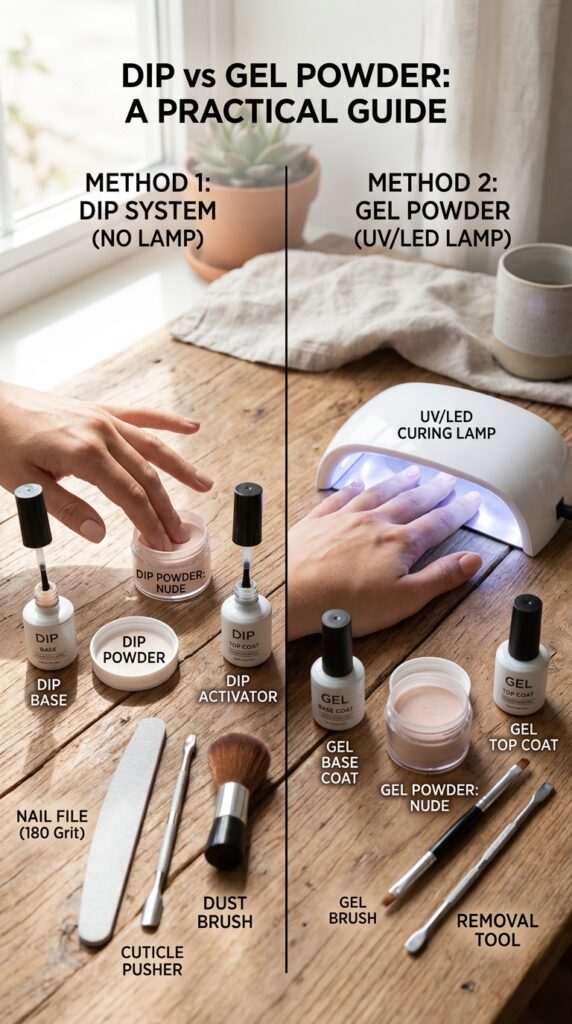
Gel can be used with dip powder, but you must follow a complete gel method rather than applying standard dip base and simply skipping activator. In a gel method, a compatible gel base holds the powder and cures under a UV or LED lamp. A compatible gel top coat then seals the manicure under the lamp.
Dipsy Dip’s official gel method instructions state that no dip liquids or activator are needed because its gel base and top coat serve those roles within that separate process. The brand instructs users to pour powder over uncured gel base, cure it under a lamp, repeat as needed, file the hardened product, and finish with cured gel top coat.
This method requires compatible gel products and the correct lamp. Do not mix random gel and dip products without checking the manufacturer’s instructions. Uncured gel on the skin can contribute to irritation or sensitivity.
8. Can You Use Gel Top Coat Without Dip Activator?
A gel top coat alone does not replace activator when you have already built the manicure with standard dip base liquids. The activator’s first job is to harden the base and powder structure before finishing. Covering soft layers with cured gel top coat may create a hard outer shell over an unstable foundation.
There are two clearer routes. Complete the standard dip system with its activator, then use the finishing method approved by the brand. Or start from the beginning with a tested gel method that uses gel base, dip powder, lamp curing, and gel top coat. The second route works without activator because the entire curing process has changed, not because top coat took the activator’s place.
Avoid switching methods halfway through unless your product manufacturer provides instructions for doing so. Mixing systems may lead to lifting, wrinkling, dullness, or incomplete curing.
9. What to Do If You Run Out Mid Manicure
Stop before filing or applying top coat. Brush away loose powder gently, then check your kit’s instructions. If you cannot replace the activator that day, remove the unfinished product using the removal process recommended by the brand rather than layering household liquids over it.
Do not force a file across a soft surface. Filing before the product hardens can drag the material, create uneven patches, and place unnecessary pressure on the natural nail. Do not peel the layers away either, since peeling can take thin layers of the natural nail with the coating.
I always recommend checking every bottle before beginning a manicure. Open the activator, wipe the bottle neck, and confirm that the brush moves freely. A spare bottle usually costs less than restarting a full manicure. Kiara Sky listed its 15 ml Seal Protect at $12.99, while SNS listed a 0.5 ounce Sealer Dry at $9 when checked.
10. How to Apply Activator Correctly
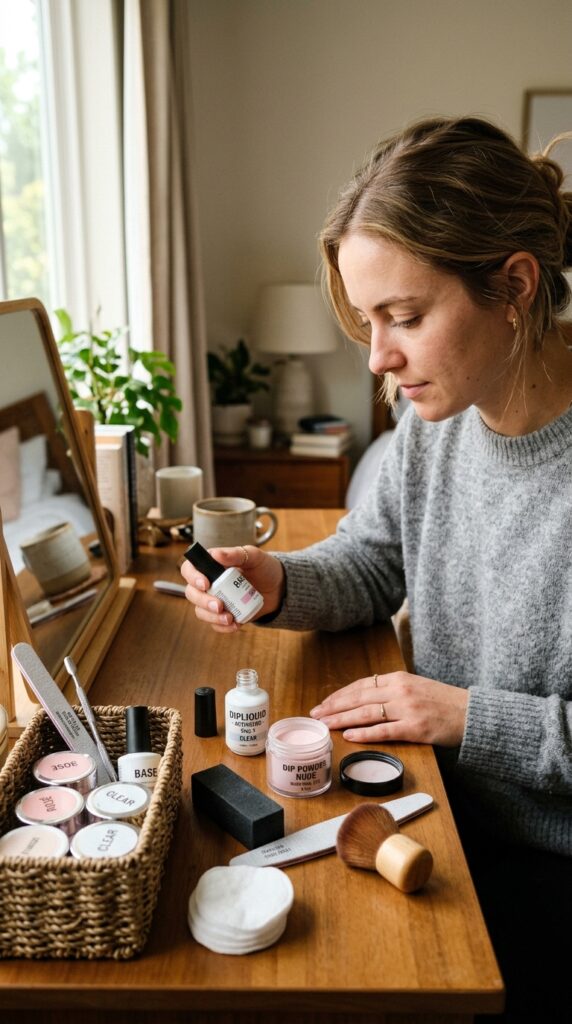
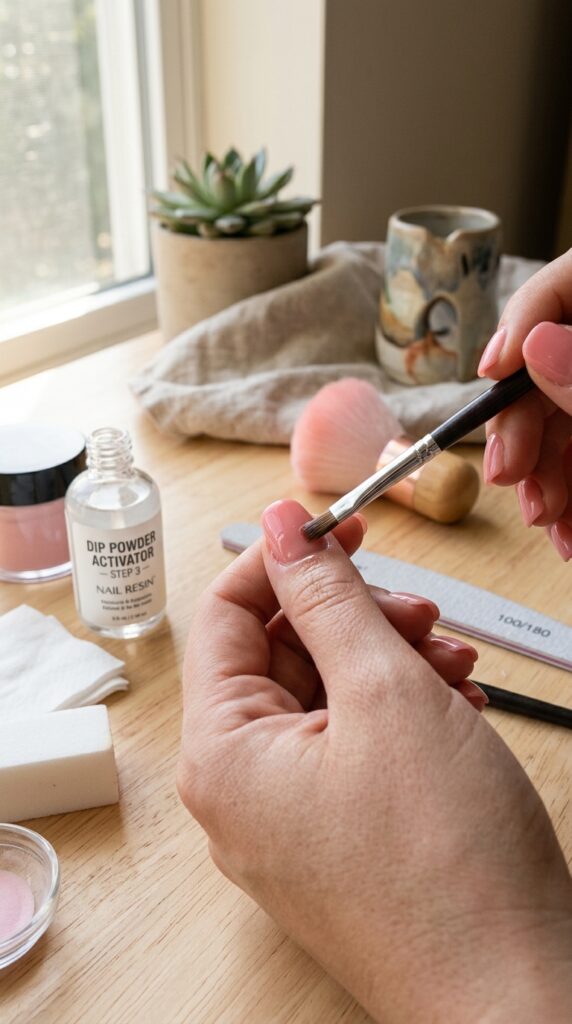
After completing your powder layers, remove all loose powder with a clean manicure brush. Apply activator over the full surface, including the sides and free edge. Use enough liquid to cover the powder without flooding the surrounding skin.
Allow the product to harden for the time listed by your brand. OPI’s current instructions call for a generous activator layer, followed by hardening before filing and buffing. The process then uses another activator layer before top coat.
Once the first application has hardened, file the shape and smooth the surface. Remove every trace of dust before the next liquid step. Dust left near the cuticle or sidewalls can create a rough finish.
A common mistake is brushing activator across the nail too quickly and missing dry spots. Work under good light and look at the nail from several angles before moving on.
11. Why Your Dip Top Coat Turns Cloudy or Your Brush Hardens
Activator and dip top coat interact closely, which is why timing and clean tools matter. Kiara Sky warns that activator can cause dip top coat inside the bottle to harden if the brush carries activator back into it. The brand recommends wiping the top coat brush with a lint free cloth before returning it to the bottle.
Too much wet activator left on the nail can also affect the final shine. Let the activator dry for the time given by your system, then wipe away filing dust and residue before applying top coat. Do not scrub the nail with random cleaners unless the instructions tell you to.
Keep separate lint free wipes beside each liquid. What I personally love about this habit is that it takes only a few seconds but can save an entire bottle. Store all dip liquids upright, tightly closed, and away from direct sunlight.
12. Should You Mix Activator From Another Brand?
Some dip liquids may appear interchangeable, but brands can use different formulas, timing instructions, and application orders. Even OPI and Kiara Sky publish their own ingredient lists and specific system directions. This makes cross brand compatibility uncertain unless one of the manufacturers confirms it.
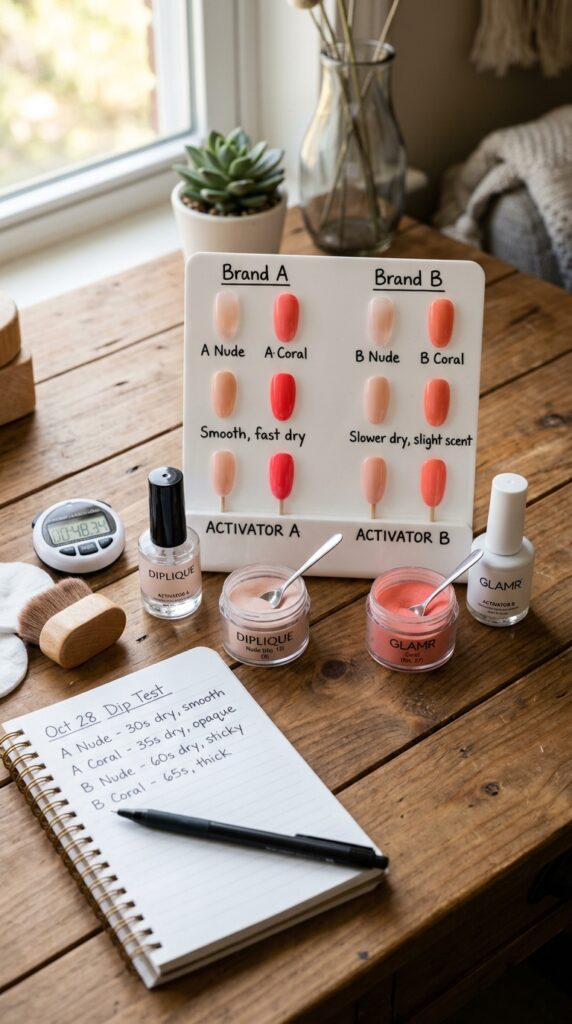
Using another activator may work in some cases, but it can also change hardening time, top coat shine, brush condition, or durability. Treat compatibility as a product question rather than a universal rule.
The lower risk choice is to buy the activator made for your current base and top coat. When that is not possible, contact the brand or test the combination on one removable nail swatch before applying it to both hands.
In my experience, the biggest mistake here is testing an unfamiliar combination during an important manicure. Experiment when you have enough time to remove and restart the set.
13. Safety Tips for Using Dip Activator at Home
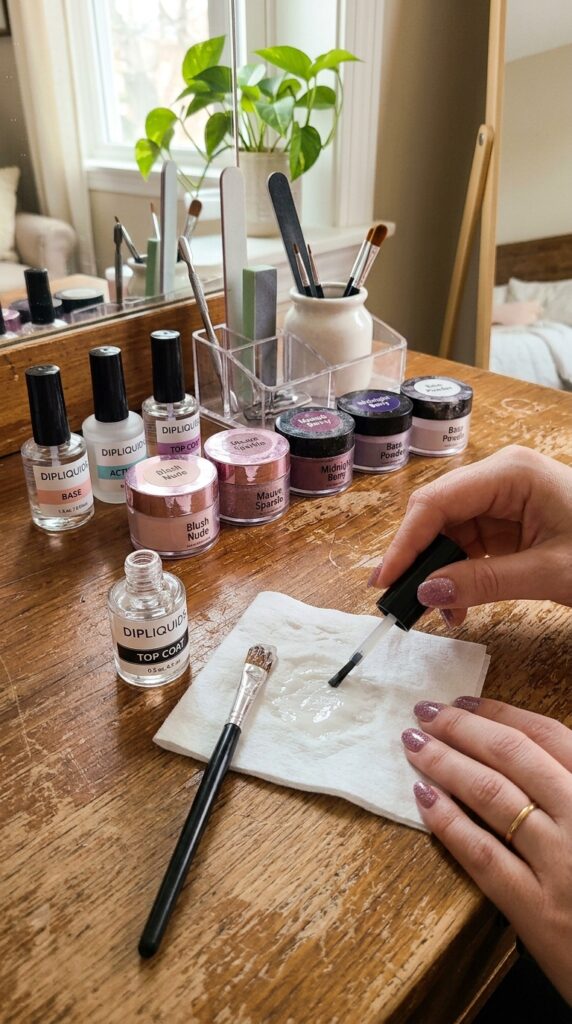
Use nail products in a room with good airflow. Keep bottles away from flames, cigarettes, heaters, and other heat sources. Avoid breathing vapors or filing dust, and prevent liquids from touching the eyes or surrounding skin. The FDA advises careful label reading, good ventilation, and attention to possible infection or allergic reactions when using nail products.
Activator formulas vary, but product safety sheets can include warnings about flammability, vapor exposure, skin contact, and eye irritation. OPI’s activator safety data sheet instructs users to work in a well ventilated area and avoid breathing mist or vapors.
Stop using the product if you develop persistent redness, swelling, itching, blistering, burning, or breathing symptoms. Remove it according to the manufacturer’s directions and seek medical advice when symptoms are serious or do not improve.
Keep liquids closed and out of reach of children and pets.
The Final Truth About Doing Dip Nails Without Activator
So, can you do dip nails without activator? Not when you are following a standard dip powder system. Activator is the step that hardens the layered product, prepares it for filing, and helps the matching finishing process work correctly. Leaving it out may create a manicure that looks dry on top but remains weak, uneven, or poorly sealed underneath.
Rubbing alcohol, acetone, dehydrator, and ordinary top coat are not reliable replacements. Buying the correct activator is usually the simplest and most affordable solution. A replacement from a known brand may cost around $9 to $13, though prices vary.
You can use dip powder without activator through a complete gel method. That approach replaces the standard dip liquids with compatible gel base, lamp curing, and gel top coat. It should be treated as a different application from the beginning.
Start by checking your own kit’s directions and testing unfamiliar products on one nail swatch. Which dip method are you planning to try? I’d love to hear what has been causing trouble with your manicure.
Can dip powder dry without activator?
The surface may begin to feel firmer as it sits, but that does not mean the layers have completed the manufacturer’s curing process. Standard dip instructions call for activator before filing and finishing. Waiting longer is not a dependable substitute. Use the activator designed for your system.
Can I use regular nail polish top coat over unactivated dip powder?
Regular top coat does not perform the hardening step assigned to dip activator. It may create a temporary shiny surface while leaving the powder structure underneath weak or uneven. Complete the dip system before applying its approved finish. Do not expect ordinary clear polish to repair an unfinished application.
Does a UV lamp activate standard dip powder?
A lamp does not replace activator in a standard dip liquid system. Traditional dip products harden through their matching liquid process rather than UV or LED curing. A lamp is used only when you choose a complete gel powder method with compatible gel base and top coat. Follow the curing times supplied with those gel products.
Why is my dip powder still soft after activator?
You may have applied too little activator, missed part of the surface, used very thick powder layers, or moved to filing too soon. Cover the full nail and wait for the time listed by your brand. Old, contaminated, or nearly empty activator may also apply unevenly. Replace the bottle when the liquid has changed texture or the brush no longer works correctly.
Do I need two coats of dip activator?
Some systems instruct users to apply activator twice. OPI applies it once before filing and again before top coat. Other brands may use different timing or quantities. Follow the steps for your exact base, powder, activator, and top coat rather than assuming every kit uses the same process.