
How to Play Guitar With Long Nails: 10 Practical Steps
Long nails can make learning guitar feel awkward, especially when they touch the fretboard before your fingertips reach the strings. Notes may buzz, chords may sound muted, and delicate nail art can chip against steel strings. You might start wondering whether you have to choose between your manicure and your music.
Learning how to play guitar with long nails is possible, but the solution depends on which hand has the extra length. Long nails on the picking hand can support fingerstyle playing because they act much like small picks. Long nails on the fretting hand create a greater challenge because the fingertips need to press the strings cleanly.
This 10 step guide covers practical compromises that let you keep more of your preferred nail style. You will learn how to adjust nail length, improve finger placement, choose easier chord shapes, use a capo, explore alternate tunings, and protect natural or artificial nails. You will also find realistic equipment costs and image prompts for each step. The goal is not to force one technique. It is to find a setup that feels comfortable and still produces clear notes.
1. Understand What Each Hand Needs to Do
The first step is identifying your fretting hand and picking hand. On a standard right handed guitar, the left hand presses the strings against the fretboard while the right hand strums or picks. A left handed player normally reverses those jobs.
Long nails create different results on each side. The fretting fingertips need close contact with the strings, so extra length can strike the wood before enough pressure is applied. The picking hand has more freedom because its nails can brush or pluck the strings. Yamaha notes that well maintained long nails can work like small picks in fingerstyle playing, creating a blend of fingertip warmth and nail attack. (Yamaha Music)
Before changing your manicure, hold one simple note with each fretting finger. Notice which nails hit the fretboard first. This test is free and helps you adjust only the length that actually causes trouble.
2. Keep Fretting Hand Nails at a Playable Length
The most reliable compromise is keeping the fretting hand shorter while allowing more length on the picking hand. You do not need to cut every nail extremely short. The free edge only needs to stay clear enough for the fingertip to reach the string without the nail pressing into the fretboard.
Test the length by placing a finger almost upright on a middle string. If the pad can press the string cleanly just behind the fret, the nail is probably manageable. If the nail touches the wood first, file it back in small stages. A soft oval or rounded shape is less likely to catch than a sharp square or pointed tip.
In my experience, the biggest mistake is shortening every nail at once before testing individual fingers. The index and middle fingers may need more adjustment than the pinky. A glass file generally costs between $8 and $20, while a salon reshaping service may cost $10 to $30.
3. Adjust Your Fretting Finger Angle
Clean guitar notes usually come from pressing with the fingertip rather than allowing the flat finger pad to rest across nearby strings. Yamaha’s classical guitar guidance recommends holding the fingers perpendicular to the fingerboard and pressing the string just behind the fret. (Yamaha) This upright position also gives moderately long nails more room.
Bring your thumb behind the neck instead of wrapping it tightly over the top. Curve the fingers and place each tip close to the metal fret without sitting directly on it. Use only enough pressure to produce a clear note. Too much force creates tension without solving a poor angle.
A lot of people let the wrist collapse inward while trying to protect their nails. Raise the guitar neck slightly or use a footrest so the fingers can approach more naturally. A guitar footrest or supportive cushion generally costs between $10 and $35.
4. Use Long Nails as Natural Fingerpicks
Long nails on the picking hand can become part of your sound rather than an obstacle. They create a clearer attack than bare fingertips and work well for arpeggios, folk patterns, classical pieces, and gentle acoustic arrangements. Yamaha explains that nails can act as substitute picks and support a hybrid finger and fingernail technique. (Yamaha Music)
Shape the picking nails so the string can slide smoothly across the edge. A rounded or softly ramped shape usually produces less scraping than a sharp corner. File underneath carefully and smooth rough areas with a fine buffer. Keep the nails similar enough in length that each finger produces a balanced tone.
What I personally love about this technique is that it turns a manicure choice into a musical tool. Avoid striking straight down with stiff fingers, since that may produce clicking and place stress on the nail. A fine file and buffer set generally costs $8 to $25.
5. Use a Pick When You Want to Protect Nail Art
A standard guitar pick lets you strum without repeatedly dragging polished nails across the strings. This is useful when you wear gel, acrylic, chrome, rhinestones, or detailed nail art that you do not want to scratch. It can also produce a more consistent rhythm while you adjust your fretting technique.
Hold the pick between the side of the index finger and the thumb. Leave only a small section exposed so it does not twist or fly from your hand. Begin with a medium pick around 0.60 to 0.80 millimeters for basic acoustic strumming. A thinner pick feels flexible, while a thicker one provides more control for individual notes.
A common mistake is gripping too tightly because long nails make the hand position feel unfamiliar. Keep your fingers relaxed and test several shapes. A mixed pack usually costs between $5 and $15. Pick holders and grip accessories may add another $5 to $12.

6. Choose Chord Shapes With More Open Strings
Some chord shapes place several fingers tightly together, which can be difficult when the nails prevent a steep fingertip angle. Open chords and simplified voicings often provide more room. You can still play recognizable harmony while using fewer fretted notes.
Start with Em, E, Am, D, Cadd9, and simplified versions of G or F. Fender notes that chord shapes can be adapted and that players may experiment with finger arrangements that suit their hands and instruments. Its guidance also recommends keeping fingers close to the fretboard and using shared fingers as pivots during chord changes. (Fender)
Practice each string separately after forming a chord. If one sounds muted, adjust that finger instead of squeezing the whole hand harder. In my experience, the biggest mistake is forcing a difficult full chord before the basic hand angle feels stable. Printed chord charts or a beginner chord book usually cost between $10 and $25.

7. Use a Capo to Make Chords More Comfortable
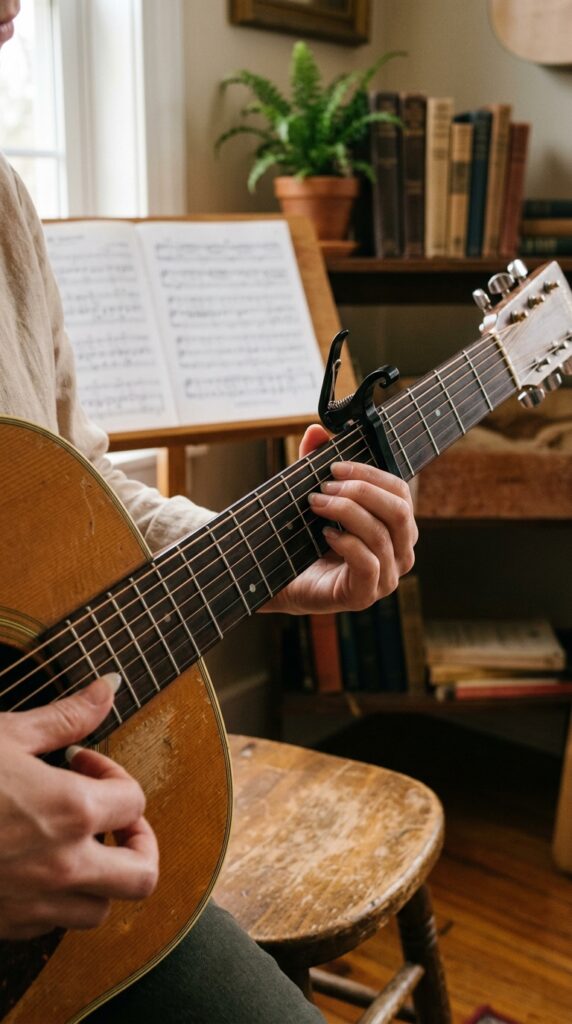
A capo clamps across the fretboard and changes the guitar’s pitch. It can also make some songs easier to play because you can replace difficult shapes with familiar open chords farther up the neck. The frets become closer together as you move toward the guitar body, which may reduce the reach required between fingers.
Choose the song’s new chord shapes before placing the capo. For example, a piece using difficult barre chords may be playable with G, Cadd9, D, and Em shapes after transposition. Make sure the capo sits just behind the fret and applies even pressure across all strings.
A lot of people place it in the middle of the fret space, which may cause buzzing or pull the notes sharp. A basic spring capo normally costs between $10 and $25. Adjustable models may range from $20 to $40. Remember that a capo helps with chord selection, but it cannot fix nails that completely block fingertip contact.
8. Ask for a More Comfortable Guitar Setup
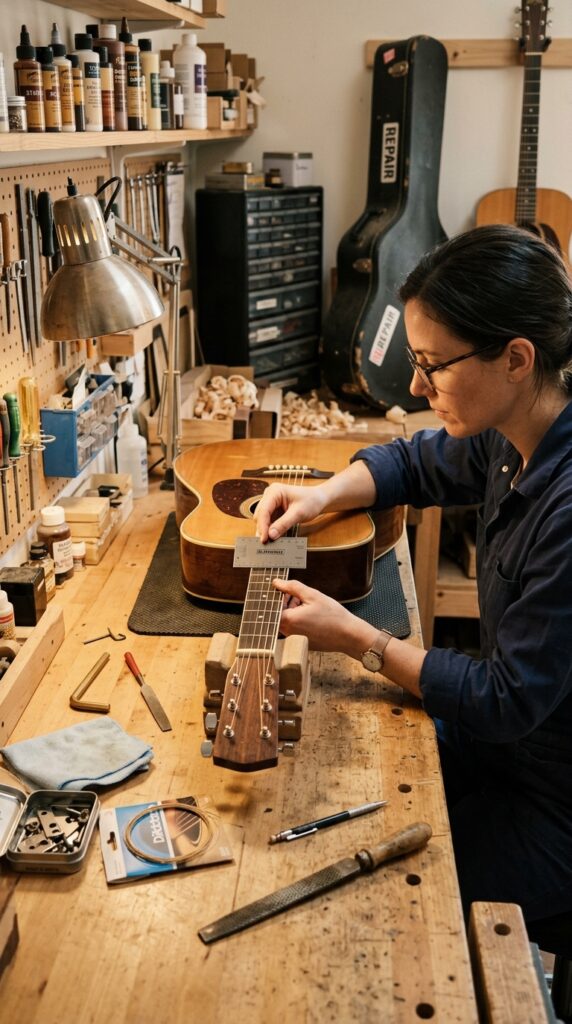
The effort required to press a string is affected by the guitar’s action, neck profile, string gauge, scale length, and overall setup. Taylor explains that these factors all influence comfort and playability and that a technician can adjust a guitar for the player’s preferences. (Taylor Guitars Blog)
If the strings sit unusually high above the fretboard, long nails may make an already difficult fretting position feel worse. Take the instrument to a qualified technician for an inspection instead of lowering the action yourself without experience. Lighter gauge strings may also feel easier to press, although they can change tone and tension.
What I personally love about a professional setup is that it improves the instrument without forcing you to compensate with excessive hand pressure. Avoid assuming every buzzing note comes from your manicure. Technique, worn frets, neck relief, and low action can also cause buzz. (Fender) A basic setup often costs between $50 and $120.
9. Try Open Tunings or Slide Guitar
Open tunings arrange the strings so they form a chord when played without fretting several individual notes. This can make guitar more accessible when very long nails limit standard chord shapes. Common examples include open D and open G, though every change should be made carefully and with a reliable tuner.
You can place one finger across several strings, play simple one finger shapes, or use a guitar slide. Fender describes slide playing as placing a metal slide on a fretting finger and moving it across the strings to change pitch. (Fender) This reduces the need to press each string directly onto a fret.
Begin with a basic open tuning lesson and write down the original tuning before changing anything. The biggest mistake is tightening a string too far while searching for a new note. A clip on tuner costs around $15 to $30, while a glass or metal slide usually costs $8 to $20.

10. Practice How to Play Guitar With Long Nails Slowly
A new hand position needs repetition before it feels natural. Begin with five to ten minutes of focused practice rather than playing through an entire song while the notes remain muted. Work on one chord, one picking pattern, or one transition at a time.
Fender recommends keeping the fretting fingers close to the fretboard and using minimal movement during chord changes. It also suggests using pivot fingers when two chords share the same fretted notes. (Fender) Practice slowly with a metronome and listen to each string. Increase the tempo only after the notes sound clean.
I always recommend recording a short video from the side. It can reveal a flat finger, collapsed wrist, or nail touching the fretboard that you cannot see while playing. Avoid practicing through wrist, finger, or nail pain. A basic metronome app is free, while a physical metronome or phone stand may cost between $10 and $35.

Find a Guitar Technique That Works With Your Nails
Learning how to play guitar with long nails usually requires a compromise rather than a complete manicure change. Long nails on the picking hand can support a bright fingerstyle sound, while the fretting hand may need shorter, rounded edges so the fingertips can reach the strings. Your guitar setup, chord choices, hand angle, and practice habits also affect how comfortable playing feels.
Start with one or two changes. Test your fretting nail length, adjust your finger angle, or try a medium pick before buying extra equipment. If chords still require too much pressure, ask a technician to inspect the guitar’s action and strings.
You do not need an expensive instrument or a large collection of accessories. A file, pick, tuner, and a few simpler chord shapes may be enough to make practice feel much easier. Give your hands time to adapt and stop when you notice pain or nail damage.
Which technique would you try first? I’d love to hear what you’re planning.
Frequently Asked Questions
Can you play guitar with acrylic or gel nails?
Yes, especially when the longer nails are on your picking hand. Acrylic or gel nails may create a bright attack when fingerpicking, but repeated contact with steel strings can scratch or loosen them. Use a pick when you want to protect detailed nail art and check for lifting before each practice session.
How short do fretting hand nails need to be?
They need to be short enough that the fingertip reaches the string before the nail touches the fretboard. The exact length depends on your fingertip shape and the curve of the nail. File gradually and test each finger instead of cutting every nail to the same length.
Is acoustic or electric guitar easier with long nails?
An electric guitar may feel easier because many models use lighter strings and require less fretting pressure. Acoustic guitar remains possible with good technique and a comfortable setup. The neck shape and string height can matter as much as the guitar category.
Can long nails damage guitar strings?
Natural and artificial nails normally will not cause immediate damage during regular playing. Rough or chipped edges may scrape against strings and produce an uneven sound. Smooth the nail edges and replace strings when they become rusty, dirty, or difficult to tune.
What guitar style works best with long nails?
Fingerstyle, open tunings, slide guitar, and simplified chord arrangements can all work well. Long picking nails can act like small individual picks. Very long fretting nails remain more limiting, so a split length manicure is often the most practical approach.